Moreness
Writings from the other side of certainty

I’m in the process of writing a philosophical memoir called Moreness. One day it will be a book. In the meantime, I thought I’d share emerging fragments.
I cared about Moreness before I heard the word. I’ve always loved how this generous and strange world spills beyond the edges of whatever frames we build.
I’m convinced that the habit and practice of Moreness enlivens the world. In these pages I hope the strange and generous emerge.
You’ll find essays here, passages from the manuscript, the occasional poem or provocation. Perhaps some music. Some of it will be finished. Some of it won’t.
I’m glad you’re here.
Kevin
Early Moreness
Reality vs the Abstract and the popping of bubble boy
I remember being on a New Jersey beach when I was probably 9 or 10 years old. I was playing in the sand, and waves would crash near enough that some of the spray would hit me. As one distinct drop landed on my arm, I remember thinking, what are the odds that out of all the water in the Atlantic, that this one tiny drop would find me! My imagination trolled the depths and width of the ocean, I saw blue whales and fish in the deep dark with lanterns hung over their heads. The enormity out flanked my thoughts. My pre-statistical brain knew the chance of that drop finding my arm was astronomically small, and the fact that I was looking at it made me slightly uncomfortable.
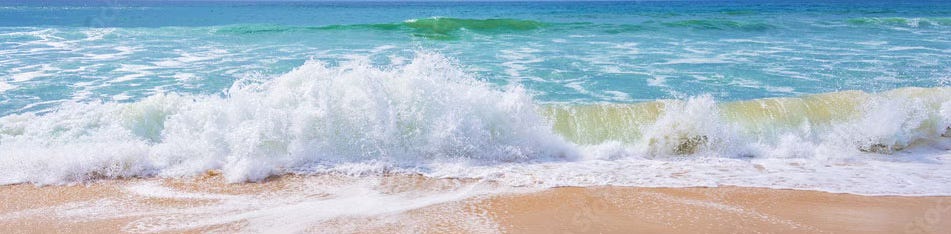
Adobe Stock Image
I figured the chances were so small that it would make more sense if no water should hit me. This conclusion came with a slight spin of vertigo. I was, perhaps for the first time, suspended above a kind of paradox. The concept of the vastly improbable was face to face with authoritative reality. An absurd image of an impervious bubble surrounded me that was designed to uphold the statistical unlikelihood that any given drop of water would find my arm. That image stuck with me these 50 years. A personal icon of the absurd lengths we go to sustain impossible ideas.
I had an internal smirk at the silliness of me as a bubble boy, and at the same moment, a rush of ‘Moreness’ arrived. I knew that as a wave broke and the spray hit the same air I was breathing, the chances that some water would hit me was 100%. There was joy in having the brute force of reality overwhelm the abstract, even when the abstract had its own kind of truth. The chances that any one molecule of water would fall on my arm out of the immensity of all of the molecules in the Atlantic, remains astronomically small, but, the chance that some water would hit me was 100%, and the idea that reality would do anything to ameliorate this tension, like create a silly bubble to protect me from this seeming paradox, was funny and appropriately ridiculous. Water was gonna do water no matter how many overwhelming statistics I could muster.
One of the ingredients of ‘Moreness’ is humility. It is about caring more about the real than your thoughts about the real.
Moreness and the Popsicle Game

Another early interaction with ‘Moreness’ was a little mental game I played. I would be sitting in the back of my parents VW Rabbit sucking a purple freezie as my mom went into the bank. And I’d ask myself, ‘Why does this taste so good?’ and I’d answer,
‘Cause it is sweet’. And that would start a cascade of ‘Whys’.
‘Why does sweet taste good?’
And I might think something cheeky like,
‘Because my tongue likes it!’
‘Why does my tongue like it?’
‘Because my brain wants it’
‘Why does my brain want it?’
‘Because my body needs sugar.’
‘Why does my body need sugar?’
‘I need energy?’
‘Why do I need energy?’
‘Because energy lets you live’?
‘Why does energy let you live?’
‘Probably because there is no life without energy.
‘Why would there be no life without energy?’
‘Because life is energy.’
And the game would end when I got to a place that was big and mind boggling. The experience was of my thoughts losing footing because there was no friction and my brain began to float beyond me. I didn’t float long. I’d just get buoyant, and go, ‘Ahh, there it is’, and go back to sucking on my freezie.
That ‘It’ has always been important to me. Knowing that just beyond the normal surface level of the day to day, was this billowing unpredictable gobsmacking ‘Moreness’.
As far as I remember, my little ‘Why’ game always worked, and I still do in one way or another. If you drill down into anything you are curious about complexity, wonder, and awe will start to bubble up. There are some postures of attention that seem to help. There is a kind of soft focus required. A willingness to not get caught up in the weeds or to get bogged down in nitty or gritty. It isn’t really an intellectual thing. Like you don’t need to name everything and have some smarty pants insight. It requires a playful and innocent stance.
Lichen and the frictionless vertigo at the end of focus
The other day I was on my first kayak paddle of the spring, and I found myself 100 feet from one of the beautiful granite walls that are painted with lichen and moss that plunge into the lakes of the Canadian Shield. The sun was beaming on its surface, and it was mirrored on the water below.
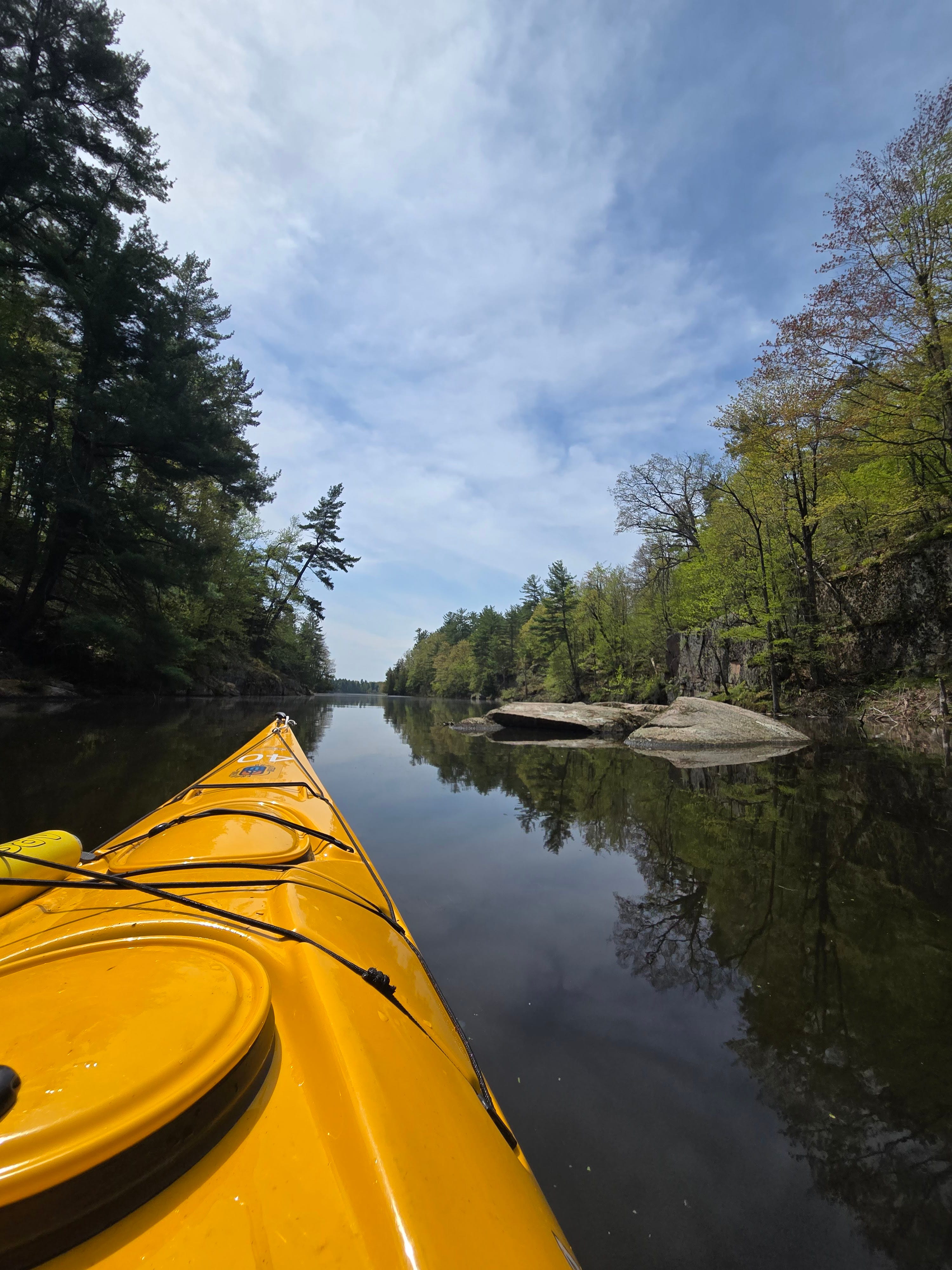
Me and my kayak around this time
This was the kind of beauty you move towards, so I paddled ‘till my boat was parallel to the rock wall and my hand and eyes were inches from the lichen. When you get close, lichen is different than you suppose. From 10 meters it seems like the brush strokes of an impressionist master, but from 10 centimeters it is more like a reef. There are bits that look like those tubular coral you might see in an aquarium, and other bits are leafy and others flowery.
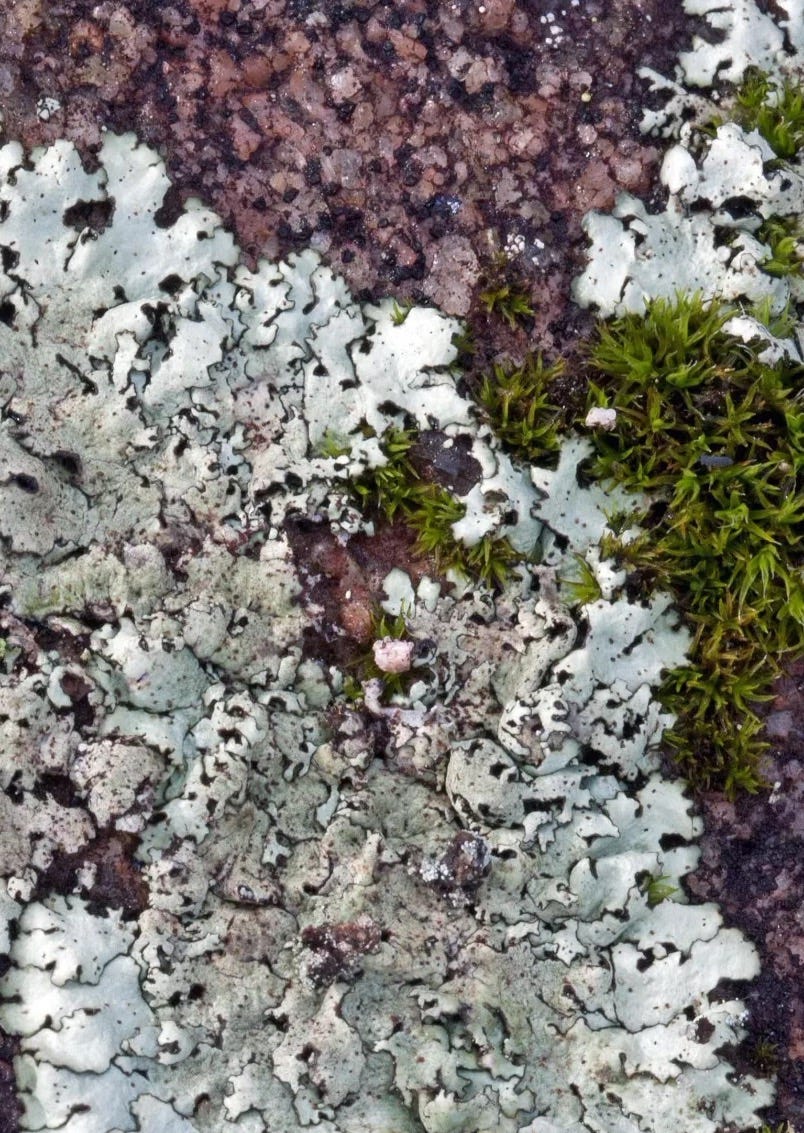
Cumberland Rock Shield Lichen and moss on wet granite (photo by Nina Munteanu)
There are parts of it that look like brain. These pieces are just big enough that you can tease them with only the very tip of your finger. At this proximity, I turned to my imagination and suspended my human scale, and imaginally entered the ecosystem. This again requires soft focus. I even conjure that sinking feeling that my belly gets in an elevator. From here I start to see more. For instance, there are tinier bugs than I knew existed. My brain could barely register them, and they were hard to sustain with sight. It isn’t clear that the concept of ‘bug’ captures them. They live beneath the radar of our attention and couldn’t bug you if they tried. There isn’t enough surface area to determine their color, but if I had to guess I’d say reddish brown. Their locomotion was beyond me. They seemed maybe in the spider realm, but no way could I count legs, but holy, those little buggers move fast. They crossed their terrain at speeds that would rival the flit of a hummingbird.
If you look at the world from the perspective of this creature, the lichen becomes an immense and gloriously weird forest. It is a world at least as sublime and as full of awe as the one in which I was kayaking. In a forest of lichen smaller than my palm, one might imagine a Richard Attenborough documentary where the camera follows both predator and prey. Some burrow in the tubuals, others camouflage while predators fly amongst the outstretched limbs of the canopy looking for a meal. And you can bet that there are scientists, let’s just call them botanists, who study and classify these ecosystems, and these tiny domains are rich and complex enough to sustain an entire life of study and curiosity. If there was a whole lab studying this palm sized ecosystem on this granite cliff just north of Kingston Ontario for the rest of my life, by the time of my death, there would be more questions than answers. We’d know some cool shit, that I’m sure of, but the ‘Moreness’ would unfold in many directions and in each the chain of ‘Why’s’ would lead the researchers towards the frictionless vertigo where they start to become buoyant as they near the end of understanding. Awe would bubble up like the champagne that will be served at my funeral.
It’s awesome possum to see you on Substack, Kev! So happy I can follow along. Love your writing and being.